
Assumption testing and plan review
Independent review of business continuity and incident response plans against widespread disruption scenarios, identifying where plans rely on the status quo.
Business impact analysis
Revisiting staff availability, travel, connectivity and supplier assumptions so recovery objectives reflect realistic conditions.
People and dependency mapping
Understanding where critical roles depend on a small number of individuals, and how caring responsibilities and travel could affect availability.
Exercising
Design and delivery of exercises built around concurrent societal disruption, including power loss, fuel shortages, cyber-attacks on infrastructure and regional severe weather.
Training and competence
Strategic, tactical and operational training mapped to the National Occupational Standards, so those expected to lead a response are trained, competent and confident.
Staff preparedness
Practical guidance and awareness sessions supporting staff to prepare their households, strengthening their ability to respond at work.
Board and leadership briefing
Briefing leadership teams on the national resilience picture and what it means for their organisation's arrangements.
24/7 Retained Incident Support
Experienced incident advisors at the end of the phone, around the clock, supporting leadership teams when disruption happens.
posted 23rd October 2026
National resilience: why it matters now
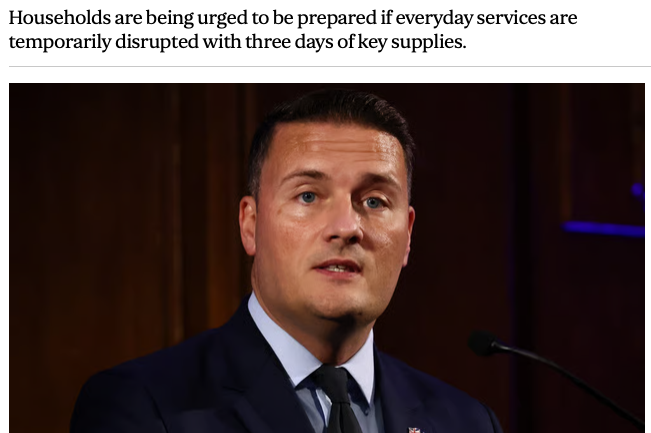
This week, the Defence Secretary, Wes Streeting, urged the public and businesses to prepare for natural disasters, cyber-attacks and hostile acts. The government launched a national resilience conversation alongside a "Be Ready" campaign, encouraging households to be able to manage for three days without normal services.
The message was to be "alert but not alarmed". Wildfires, winter flooding, supply chain disruption and increasingly sophisticated cyber-attacks were all described as challenges the country needs to be ready for.
For emergency planners and resilience professionals, none of this is new. What is new is the volume. Resilience is being discussed in public, at a national level, in a way it has not been for many years.
That creates an opportunity, and a question every organisation should ask.
If households are being asked to prepare for disruption to the society around them, are organisations prepared for the same thing?
The status quo assumption
Most business continuity and incident response arrangements are built on an unspoken assumption: that the incident happens to the organisation, while the world around it carries on as normal.
- A server fails, but the roads are open.
- A building is lost, but staff can travel to an alternative site.
- A key supplier fails, but others are available.
- Staff absence rises, but schools are open, fuel is available and phones work.
Plans are written, tested and signed off on that basis. In many cases, that is reasonable. Most incidents are local and contained.
But the scenarios now being discussed nationally are different. Widespread power loss. A major cyber-attack on infrastructure. Severe weather affecting a whole region. Fuel supply disruption. These do not happen to one organisation. They happen to everyone at once, including your staff, their families, your suppliers and your partners.
What concurrent societal disruption looks like
The Iberian blackout of April 2025 offered a clear illustration. Power was lost across Spain and Portugal. Traffic signals failed across Madrid and other cities, leaving roads gridlocked. Metro and rail services stopped. Mobile networks struggled. Card payments failed.
None of that was an organisational incident. All of it would have affected an organisation's ability to respond.
Consider what that means in practice.
Staff cannot get to work
Fuel shortages, gridlocked roads, failed traffic signals and suspended public transport can stop staff reaching their workplace, however willing they are. The UK saw a version of this during the fuel supply disruption of 2021.
Working from home is not a fallback
Remote working has become the default continuity workaround. It depends on power, broadband and mobile networks: the very services most likely to be affected.
Staff are worried about the people they care for
If a school loses power or water, it closes. Children are sent home. Elderly relatives may need checking on. Staff will, rightly, put their families first. Plans that assume staff availability without accounting for caring responsibilities will overestimate how many people can respond.
Communication fails
Call cascades, messaging apps and email all assume working networks. If staff cannot be reached, they cannot be mobilised.
Suppliers and partners are affected too
Mutual aid arrangements, alternative suppliers and partner support all assume someone else is unaffected. In a widespread event, everyone is managing their own disruption.
Payments and systems stop
As the Defence Secretary noted, if card payments fail at the till, everyday transactions stop. Organisations dependent on digital payments, procurement systems or online services face the same problem.
A double burden for responders
For local authorities, NHS organisations and other responders, the challenge is sharper still.
These organisations are expected to lead and support their communities during a widespread emergency, opening rest centres, protecting vulnerable residents and maintaining critical services, at precisely the moment their own staff are affected by the same disruption.
The staff member expected to run a rest centre may have children at home because their school has closed. The on-call officer may not have fuel. The colleague expected to staff a control room may be unable to get there.
Response arrangements that do not account for this risk falling short at the moment they are needed most.
And that is before we consider the response itself
Everything above concerns whether people and resources are available. It does not yet address whether the organisation's response is fit for purpose.
Even with the right people in the right place, the questions remain:
- Is the response embedded across the organisation, or held by a small number of individuals?
- Has it been practised, under realistic conditions, recently?
- Are staff in key roles trained and competent, against recognised standards?
- Are plans current, usable and reflective of today's risks?
- Do leaders understand their roles in strategic and tactical command?
- Has learning from previous incidents and exercises led to change?
A plan that has never been tested against a widespread, concurrent scenario is an assumption, not an arrangement.
Three questions worth asking
As national resilience moves up the agenda, every leadership team should be asking three questions.
1. Would our arrangements hold?
Not during a contained, local incident, but during widespread disruption, when staff, suppliers, partners and infrastructure are all affected at once.
2. What is the cost of not closing the gap?
For responders, the consequences fall on communities. For every organisation, there are operational, governance, financial and reputational consequences.
3. Can we evidence it?
If arrangements are examined after an incident, by boards, regulators, elected members, inquiries or the public, the question will be whether reasonable preparations were made for foreseeable risks.
The national resilience opportunity
The national conversation on resilience gives organisations a clear reason to revisit their arrangements, and a public context that makes the case to boards and leadership teams easier to make.
It is an opportunity to:
- challenge the assumptions underpinning business impact analysis and continuity plans
- understand staff dependencies, including caring responsibilities and travel
- test arrangements against widespread, concurrent scenarios rather than contained incidents
- strengthen joined-up working with partners before an incident, not during one
- encourage personal and household preparedness among staff, which directly supports organisational resilience
- embed competence and confidence across the organisation, not just within the resilience team
Staff who are prepared at home are more able to respond at work. Organisational resilience and household resilience are closely connected.
Why Applied Resilience
Applied Resilience is the UK's first Public Service Mutual dedicated to resilience.
Our team are practitioners, managing live incidents, not recounting them.
Experience at every level of the UK response
Our team has worked across the full breadth of the UK's response structures: from local and regional coordination, through strategic and tactical command, to direct involvement in national crisis response through COBR. We understand how decisions flow between local, regional and national levels during a major emergency, and what that means for the organisations expected to deliver on the ground.
Working with national and government bodies
Alongside local authorities, health providers, emergency services and Local Resilience Forums, we work with a number of central government bodies in the resilience and emergency planning space, and with national sector organisations responsible for critical services and infrastructure. That gives us a clear view of how national resilience policy translates into local delivery.
Understanding the defence and civil resilience interface
As national resilience and national defence become more closely linked, organisations need to understand how the two connect. Our team has a deep understanding of the interface between defence and UK civil resilience, including how military support to civil authorities is requested and coordinated, and how organisations fit within a whole-of-society approach to preparedness.
Independent, trusted and tailored
We are confidential, neutral and free of conflicts of interest. Our contracts are fixed cost. Our work is hands-on and tailored to your organisation.
We understand what widespread disruption looks like in practice, from the national picture down to the individual staff member trying to get to work, and what it asks of the people expected to respond.
FAQs